

Some economic data points create headlinesm, positively or negatively. Others show up quietly in obscure datasets that most people never read (except me and a few other nerds).
Housing permits sit in that second category.
Before people move, before companies expand, before schools fill and restaurants open, someone has to decide to build. That decision often happens years before the ultimate resident arrives. Housing permits function as a forward-looking economic indicator — a bet by the market on where people will want to live in the future.
And in 2025, the signal for Connecticut was striking.
Connecticut ranked #1 in the United States in housing permit growth.
According to the U.S. Census Building Permits Survey, Connecticut authorized 7,009 housing units in 2025, an 18.3 percent increase over 2024 — the fastest growth rate of any state in the country.
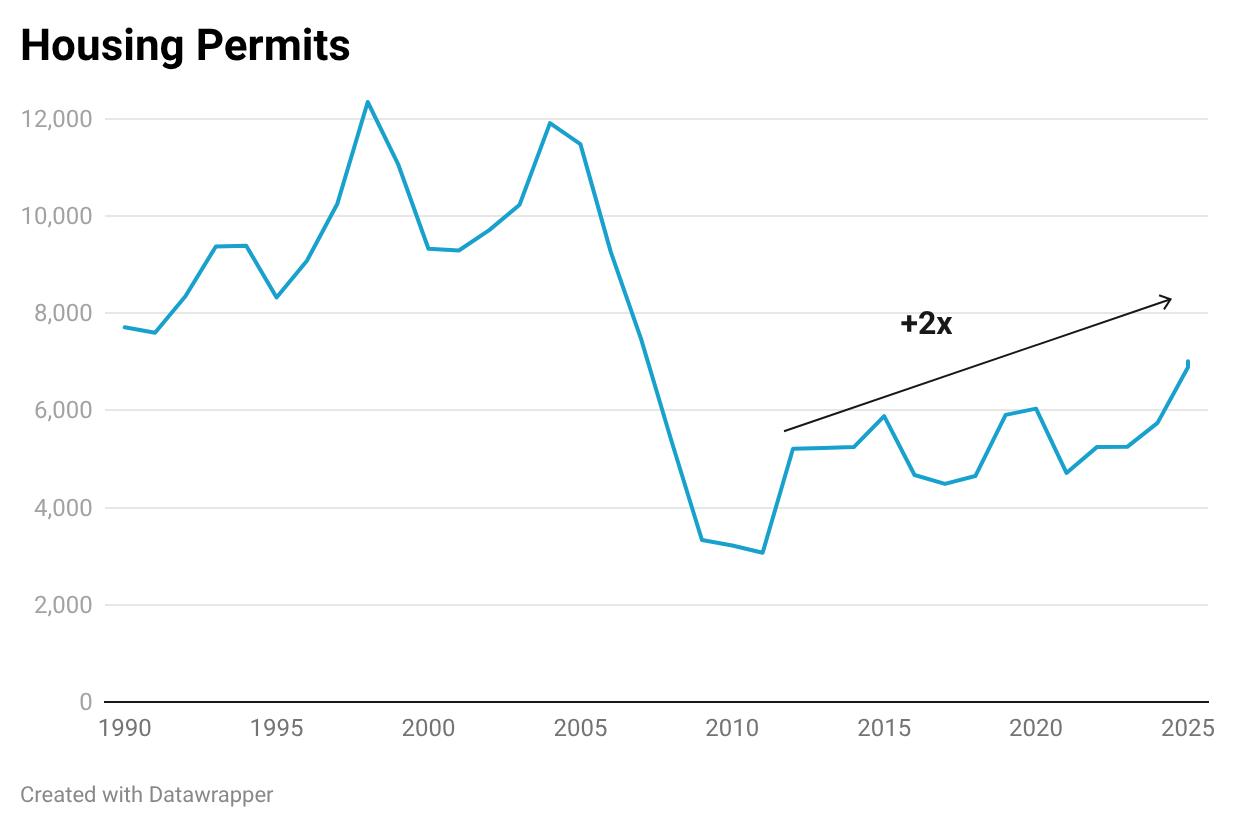
For a dataset that rarely makes headlines, that’s a notable signal.
But the more interesting story emerges when you place that number in the longer arc of Connecticut housing.
The long arc of housing construction
For much of the late twentieth century, Connecticut housing growth was driven by suburban single-family development.
During the late 1980s, housing permits exceeded 15,000 units per year. New subdivisions expanded outward from cities into surrounding towns, and the dominant housing form was the detached single-family home.
That pattern began to shift in the early 1990s as population growth slowed and the Northeast economy restructured.
Then came the financial crisis.
Following the housing collapse of 2008–2009, residential construction fell to historic lows. In some years during the early 2010s, Connecticut authorized fewer than 3,000 housing units statewide.
The recovery since then had been gradual, and recently accelerated. But something interesting happened during that recovery. Housing construction did not simply return to its previous pattern.
Instead, the composition of housing began to change.
A structural shift in what we build
The 2025 data illustrate this shift clearly.
Of the 7,009 housing units authorized in Connecticut in 2025:
- 2,082 were single-family homes
- 156 were duplexes
- 159 were 3–4 unit buildings
- 4,612 were units in buildings with five or more units
In other words, roughly two-thirds of new housing permitted in Connecticut today is large multifamily development.
A generation ago that would have been unusual.
For decades, the housing economy of the Northeast revolved around suburban subdivisions and single-family homes.
Today, the majority of new housing units are apartments, importantly with a particular emphasis on affordable housing.
Why supply doesn’t respond quickly
I get frustrated by the pace of housing supply growth because the demand is clearly there. But it's one of many things where I wish I could wave my magic wand, but the system itself is complex. And one additional factor helps explain why housing production has struggled to return to earlier levels: construction itself has become more expensive.
Federal data from the Bureau of Labor Statistics show that the Producer Price Index for residential construction inputs has risen significantly over time, reflecting increases in the cost of materials such as lumber, steel, and other building inputs.
Construction costs have generally increased faster than overall inflation, and pandemic-era supply disruptions pushed many materials sharply higher.
The result is a structural reality:
building housing today is significantly more expensive than it was a generation ago.
Which makes it harder for supply to respond quickly when demand rises.
The signal behind the numbers
But the important point is that demand is clearly there.
An 18 percent increase in housing permits, ranking #1 in the United States, suggests that developers see that demand.
Developers only assemble land, secure financing, and commit capital when they believe people will want to live there in the future. And they see what I see: an economy that is booming, and a population that keeps growing.
Housing permits are yet another market vote of confidence.
The opportunity ahead
That said, the absolute scale of construction remains below where I want to see it. 7k units is not a large number for a state of 3.6 million people.
We can do more, and we will.
Because behind every housing permit is a simple idea: the market is picking a place where people will want to live.
And now more then ever that is Connecticut.